Its standing in the industry speaks for itself: its launch ended China's history of importing rotary offset presses, filled a domestic technology gap, and further cemented China's position in label-printing machinery manufacturing.
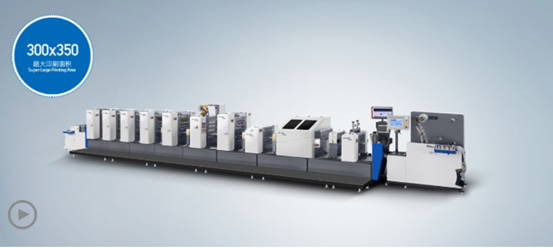
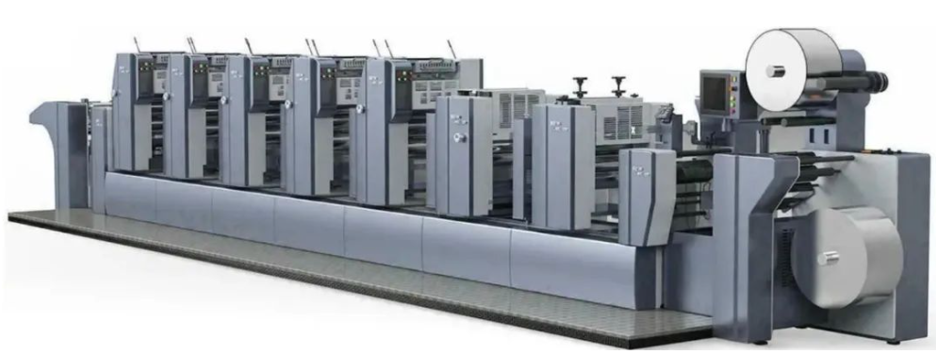
The Intermittent PS-Plate Offset Press
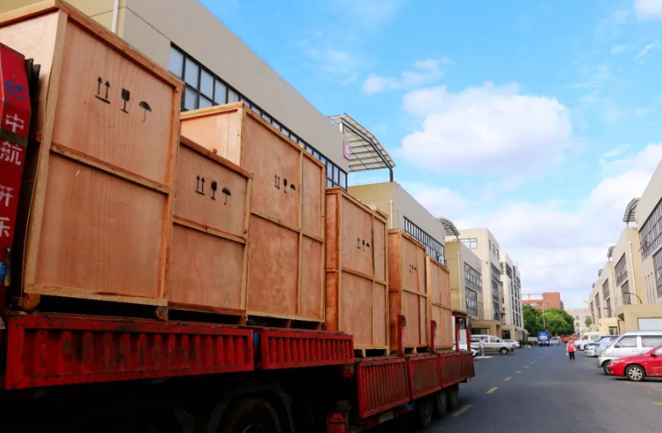
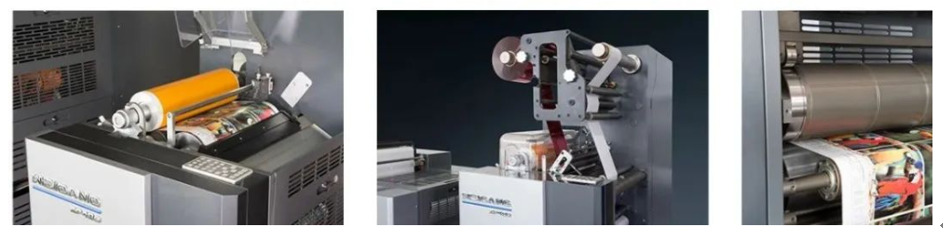
Printing units: genuinely heavy-duty, high-quality offset units, each with 19 ink rollers (including 4 form rollers) and 4 dampening rollers. The well-designed inking train effectively prevents ink streaks and ghosting, lifting print quality to a fineness and clarity that letterpress machines cannot match. Intermittent PS-plate printing (web offset) is ideal for mid- and small-run as well as long-run high-end labels — the ideal press for premium self-adhesive labels. Extra-large 300 x 350mm print area with a maximum repeat of 350mm. A high-precision computerized optical tracking system ensures repeatable front-to-back register, expanding label design possibilities. Shaftless drive: every unit is driven by its own servo motor — fourteen servos in all on the six-color press — guaranteeing registration accuracy at high running speeds. Register system: lateral and circumferential adjustment on each printing unit is controlled by independent motors (replacing the old practice of walking to each unit to adjust by hand, which both strained operators and wasted material). Standard still-image monitoring lets operators adjust lateral and circumferential register from the console without stopping the press, effectively raising print quality and output.
The PS-plate offset press greatly strengthens Lingmin's ability to respond to small-batch, multi-SKU, high-precision printing demand, with fast changeovers and scientifically optimized plate costs — delivering richer customized service to customers.
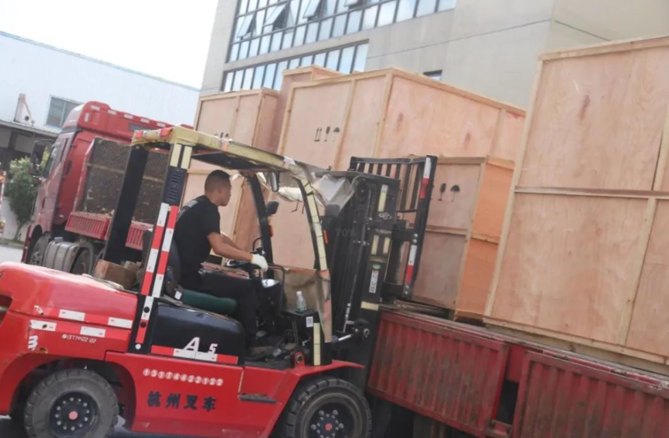
With this, Lingmin has completed a full label-printing production line-up: letterpress with a full-rotary label press and a 7+2 intermittent letterpress; flexo with a high-speed flexo press; screen with a screen-printing machine; and digital with a digital press, UV double-sided inkjet coding equipment, and a sheet-fed duplex digital printer.
With the intermittent PS-plate offset press in place, this end-to-end equipment configuration and versatile line-up can meet virtually any customization need, as Lingmin keeps forging a more comprehensive, higher-quality service capability. Lingmin is also Fengxian District's top taxpaying printing enterprise, a 2022 Shanghai Fengxian Industrial Foundation Strengthening project unit, and a SEDEX EU member; it has repeatedly been named an Outstanding Packaging Supplier to China's crop-protection industry, won the China Crop Protection Industry Association's Innovation Contribution Award several times, and earned honors including China's Top 50 Most Influential Label Brands, Top 5 nationally for logistics labels, and SF Express Quality Supplier 2021.
Lingmin is ISO 9001 quality-certified and operates in an environmentally friendly manner, holding an Environmental Completion Acceptance Report from the Fengxian Environmental Protection Bureau, FSC forest certification, and a Dun & Bradstreet financial rating of A. Building foundations through perseverance, growing with the trend — Lingmin keeps raising its integrated service capability and stands ready to serve. Feel free to get in touch.
Quality Traceability Management | The New Wave of Ready-to-Cook Meals
Reportedly, after major players such as Country Garden, Nongfu Spring, and Shenzhen Metro entered the ready-to-cook meal race, courier giant SF Express formally announced a full push into the sector. SF's supply-chain solution for ready-to-cook meals links the industry end to end through a three-in-one approach, covering everything from online business to offline scenarios. Its industry-first integrated logistics model — trunk-and-branch transport + cold-chain warehousing + express delivery + intra-city delivery — comes with a food traceability system and real-time visual temperature and humidity monitoring across storage and transport, keeping dishes safe and fresh while comprehensively raising omnichannel fulfillment capability.
iiMedia Research data put China's ready-to-cook meal market at RMB 345.9 billion in 2021, up 19.8% year on year, with the sector forecast to grow around 20-30% annually from 2022 to 2026 — positioning it to become the next trillion-yuan dining market within three to five years.
Every boom meets resistance. China's ready-to-cook meal industry is still in its infancy, and some real problems demand attention — above all, the lack of effective production, food-safety, and quality-control standards, which leaves processing quality wildly uneven across regions and company sizes and product quality highly variable. How to guarantee food safety and win consumer trust has become the crux of the sector's development.
One-Item-One-Code Meets the Safety Oversight Needs of Ready-to-Cook Meals
During the pandemic, long stretches at home stoked people's enthusiasm for cooking, even as modern consumers pursue convenient, fast lifestyles. As food technology advanced, ready-to-cook meals answered much of that demand, though menu range and flavor fidelity still need improvement — and above all, quality traceability must earn consumers' confidence. Standards for ready-to-cook meals are rolling out across the country, safeguarding high-quality development from production processes through after-sales service. When application scenario meets specific pain point, one-item-one-code quality management enters the ready-to-cook market as if by destiny — love at first sight. One-item-one-code captures data at key checkpoints and binds it to a single QR code, a perfectly matched value proposition that serves as the key to anti-counterfeiting, quality traceability, and marketing management. Assigning each ready-to-cook product its own code enables safety risk control, counterfeit crackdown, anti-diversion, effective channel management, precise reach to end consumers, and productive use of data. For consumers, scanning to verify authenticity and trace raw-material origins is the key to dispelling doubt and building brand trust — and the one-item-one-code precision-marketing system can engage them at the scan, building stickiness and repeat purchase, and perfectly paving the way for brand traffic pools and precision marketing.
One-Item-One-Code in Action
Tailored to the characteristics of ready-to-cook meals and grounded in food safety, Lingmin Packaging uses one-item-one-code to cover the product's full lifecycle — raw materials, production, quality inspection, packaging, warehousing, logistics, marketing, and the retail endpoint — with information traceability, data linkage, and sharing at every step, delivering brand anti-counterfeiting, quality traceability, digital coding, digital channels, digital marketing, and data insight. Lingmin is committed to digital packaging and intelligent platform solutions, to building a safe, stable, responsible industry supply chain, and to forging a Chinese smart-manufacturing brand in printing. Its full-chain traceability model starts at raw materials, traces the production process, and enforces quality control at every critical point; in circulation it supports warehouse and logistics management, and in the marketing phase it enables channel management, internal audits against diversion, scan-code applications for key roles at each stage, and panoramic marketing — finally mining and analyzing the data gathered along the way to feed insight back into production decisions.